|
|
|
A world music instrument...

Instrument for children, poor people and vagabonds,
the harmonica, rooted in Asia, leaves its European
cradle to conquer the New World with an
African breath.
|
|
The
harmonica was born at the beginning of the XIXth century in central Europe.

|
The term harmonica had already been used in
German to designate all kinds of instruments, very different from the one we know today.
Among others was the glass harmonica, composed of several crystal receptacles, each filled
with different amounts of water. The musician then rubbed his moistened finger around the
rim.
In the XVIIIth century, Father Amiot - a Jesuit- brings a "cheng"
back to Europe from China. On this sacred instrument, the sound is produced by free reeds
vibrating under the musician's breath.. European inventors used this principle in
developing other instruments that could be as expressive as the human voice.
In 1821, the young F.Buschman assembles small instruments he calls
" Aura "s, and sells them like hot cakes.
Shortly after, the bohemian Richter invents inhaled notes and designs the tuning that
bears his name, still in use today.
One of these "Aeolines", was offered to a girl from Wurtemberg, , which gave her
fiancé, a clock maker, the idea to manufacture them. This activity spread to the other
clock makers of the area.

In 1857 Mathias Hohner creates the first harmonica factory and produces 700
instruments. Thirty years later, he was manufacturing a million harps a year! |
| The harmonica was
exported as early as 1862 towards America |
When many Germans were emigrating to the USA,
Hohner offered a small cheap instrument, easy to play, light to carry, and extremely
expressive.
It seems, however, that hand crafted harmonicas were played on the American continent
before that and were even used to trade with the Native Americans (Can any of you tell us
more about that ?). |
| In 1896 the Marine
Band is patented especially for the US market |

|
|
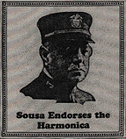 Its name comes from the famous John
Philip Souza orchestra. Ten holes, twenty reeds, three octaves, barely four inches long,
available in every major key: it will become a must. |
It is also the
cheapest instrument that uses sustained notes |
Musicians soon pulled extraordinary sounds out
of the instrument that the inventors had never imagined.
Sears and Roebuck replaced the itinerant peddlers, and many children started getting
"mouth organs", " french harps" , or "pocket
pianos" as presents. |
|
 For some of them, it would
be the key to the highway... |
|
|
|