The hands Hold
the harmonica between the thumb and the index
finger of your left hand, the low notes on your
left.
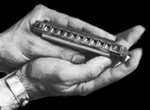
Place your right hand behind the instrument to
form a cup with the fingers of your left hand.
Choose a comfortable position : the right hand
should be able to move easily to modify the sound
or activate the button on the chrom.
The lips
Wrap your lips loosely around the mouthpiece
of the harmonica and pronounce the letter
" O ".
The harmonica should rest on the wet inner part
of the lips. This way you get a better air seal
and the harmonica slides without hurting.
The tongue
Studying the harmonica will prove without a
doubt that the tongue is a wonderful instrument !
- In "normal" playing, the tongue is
loose and " flat ", the tip
touching the bottom front teeth.
- Tonguing is using the tip of the tongue to
articulate syllables (TA, KA, GA ...) varying the
attack of the notes : from legato to (very)
staccato.
- To bend the notes, pull the tongue back toward
the throat, and let the tip drop down below the
bottom front teeth...
Other tongue techniques :
Trills
To make trills, cover two holes and move the
tongue rapidly from side to side which alternates
the air flow between the two notes. 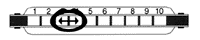
Harmonizing
Cover several holes with your mouth and use the
tip of the tongue to block the central ones,
splitting the air in order to play selected notes
simultaneously.

Tongue blocking
Cover several holes with your mouth, play the
melody with the corner of the mouth (more often
on the right side), use the tip of the tongue to
rhythmically block the other holes (generally the
ones on the left).
Bending
The bending technique adds life and expression
to your playing but most of all gives access to
notes that are not in the original structure of
the harmonica.
This is particularly effective on the Marine
Band ten hole, single reed, diatonic model.
By changing the shape of your mouth you can
lower the note you are playing while drawing on
the first six holes and blowing on the upper four
ones.
The explanation is simple even if it will take
a little time to apply: start on the fourth hole
drawn, for instance. Imagine the air is a ping
pong ball that you are trying to pull (to the
back of your throat) with your tongue. Or, still
while inhaling, pronounce Ahhhhhhh quietly, then
KOUH very loudly. Try the same thing but instead
while blowing into the ninth hole.
The result is that both of the reeds in the
same hole vibrate together to offer you the
intervals between them. On a C harp, the fourth
hole drawn bends from D to C ; the ninth hole
blown bends from G to F etc...
The jaw
The lower your jaw, the fatter your sound, the
higher the pitch. Note how the sound becomes more
piercing when you tighten your teeth.
The throat
You can get a deep vibrato effect by using the
throat as a rhythmic valve:
pronounce Ah Ah Ah Ah... (without vocalizing !).
Try to modulate intensity and speed using the
mood and the tempo of the music.
The nose
The nose helps you to regulate the flow of air
when you play. Be careful to not let the air leak
through the nose or at the corners of the lips
when you blow.
Overblowing
Overblowing (or overdrawing) allows you to
achieve a complete chromatic scale on the ten
hole diatonic by blowing in a special way into
the first six holes and drawing the same way on
the four upper ones ; exactly where you cant bend
!
Overblowing (or overdrawing ) gives you extra
notes over the highest one in the hole. For
example on a C harp: Eb overblown on the fourth
hole or Ab overdrawn on the ninth hole.
This technique is similar to bending but a
little more difficult to master because you
can’t pass gradually from the original note
to the overblow.
Try this: blow softly on hole six of a C harp (G)
pronouncing Ahhh, then blow harder in the same
hole pronouncing Veeee. The gap between the reed
and the reedplate should not be too big to obtain
overblows easily.
Try this chromatic scale :
Difficult... but exciting !
 for more details...
|